How OBRIT Consulting leveraged vibe coding, Claude Code CLI, and Codex CLI to launch an education app in production and pave the way for the next wave of MCP agents.
Why jump in?
For more than 15 years, OBRIT Consulting’s founder Olivier Braeckman has supported product teams, led discovery work, and designed user journeys. Yet something was missing: the ability to turn those scenarios into code without waiting for a backlog slot or a sprint commitment. Vibe coding and agentic tools became the trigger. In May 2025, OBRIT chose to move from framing to shipping.
The mission was clear: craft an education platform for Olivier’s wife, a pre-school teacher, from scratch but on a stack the team knows inside out (MySQL, Spring Boot, Angular). The hidden ambition: prove that AI could act as a cofounder while keeping the codebase production-grade and maintainable.
Vibe coding: human + AI in flow
Vibe coding isn't about generating random snippets; it's an ongoing dialogue where the AI becomes a creative copilot. With Claude Code CLI and Codex CLI, every feature turned into a conversation:
- Business needs and technical constraints are spelled out in natural language.
- The AI proposes an architecture; the OBRIT team challenges and iterates.
- Outputs are validated against house standards (tests, naming, maintainability).
- Checks are run and the feature ships to production.
🚀 The result ? in just a few weeks, KiddyClass moved from concept to production with a quality bar that stands up to long-term maintenance.
📢 The best feedback? Teachers reporting that the platform is already saving them serious time.
Tech stack and code organization
OBRIT Consulting selected a familiar stack to stay focused on product design:
- Back end: Spring Boot, REST APIs, security handled by Firebase Auth plus dedicated API keys.
- Front end: Angular, a lean design system to deliver consistency to teachers.
- Database: MySQL, structured around classroom routines (workshops, skills, assessments).
- Pipelines: GitHub Actions for CI and a repeatable deployment chain.
Each iteration flowed through AI-guided QA with human oversight: simulated PR reviews, targeted unit tests, incremental documentation. Vibe coding delivered the speed; product rigor kept the quality high.
Architecture snapshot
Here's the architecture OBRIT Consulting converged on, distilled from the detailed design document powering the MCP roadmap:
Conversation-to-Classroom Flow
Teacher
  |
  | voice / text prompts
  v
+--------------------------------------+
| MCP Chat Agent (Claude, Codex, etc.) |
+--------------------+-----------------+
                     |
                     | Model Context Protocol
                     v
             +------------------+
             | MCP Server Core  |
             |  (Spring Boot)   |
             +----+-------+-----+
                  |       |
        tool calls|       |domain services
                  |       |
        +---------v-+   +-v-------------------+
        | Tool APIs |   | Curriculum Tooling  |
        | (REST)    |   | (Planner, Analyzer) |
        +----+------+   +-----+--------+------+
             |                  |
   +---------v----+     +-------v-------+
   | Angular App  |     | MySQL + AI KB |
   | (Teachers)   |     | Referentials  |
   +--------------+     +---------------+
Front stage: teachers still use the Angular app day to day while the chat agent becomes a natural-language control panel.
Backstage: the MCP server reuses the existing Spring services, wraps them as tools (referential analyzer, planner, upload), and enforces API-key security with rate limiting.
Knowledge backbone: MySQL remains the source of truth; curated datasets feed the agent context without duplicating data.
From assistant to teammate: the road to an MCP server
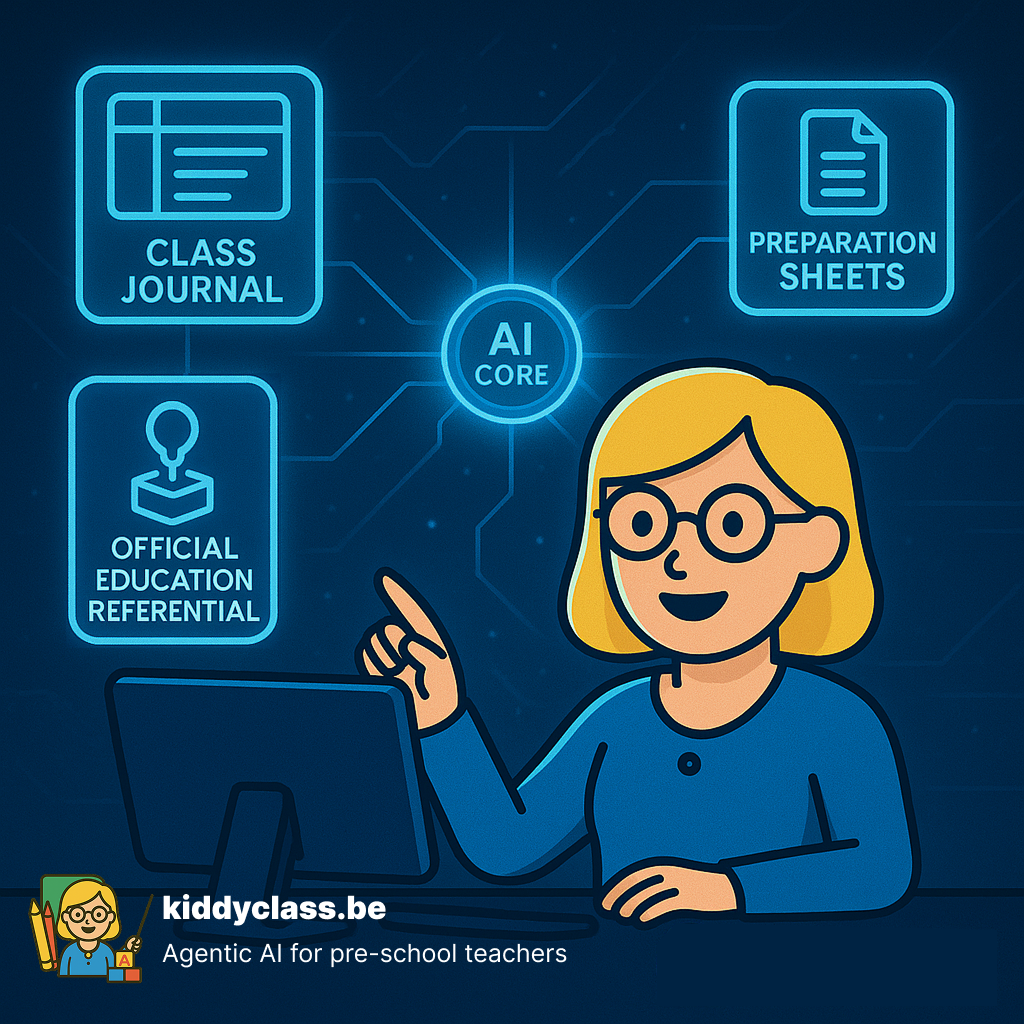
The next chapter is already underway. OBRIT is integrating an MCP (Model Context Protocol) server directly into the KiddyClass backend, paired with a specialized chat agent. The goal: give teachers a digital teammate capable of orchestrating complex classroom workflows.
What the agent will do:
- Analyze class competency frameworks and suggest the right workshops.
- Generate classroom plans based on student profiles and assessment targets.
- Automate reporting (parent summaries, inspection-ready overviews).
- Create a two-way bridge between real-world feedback and stored data.
The documented MCP architecture lets the team reuse what already exists: the same Spring services, the same MySQL database, reinforced with a robust agentic layer (API-key auth, rate limiting, interaction auditing). Tools like Claude Code CLI remain central for prototyping and testing conversational scenarios quickly.
What this journey taught us
- AI is a courage multiplier. It dramatically shrinks the gap between product intent and shipped software.
- Maintainability is non-negotiable. Even with AI, you need a human guardrail to enforce clean architecture.
- Time-to-value wins. Shipping a usable version quickly brought decisive real-world feedback.
- Agentic AI changes delivery. Software is no longer coded in isolation; teams now orchestrate agents that execute alongside them.
“Agentic AI isn't a buzzword—it's a new production loop where ideation, implementation, and validation unfold in parallel.”
What's next?
The coming weeks are all about:
- Finalizing the MCP server and deploying it in a secure environment.
- Connecting the chat agent to concrete use cases (workshop creation, progress tracking).
- Rolling the experience out to a wider circle of teachers to sharpen the product.
- Exploring integrations with other EdTech players across the francophone ecosystem.
If you're curious how agentic AI can accelerate your own projects—or you're looking for a partner to make the leap—OBRIT Consulting would love to start that conversation. This era is just beginning.